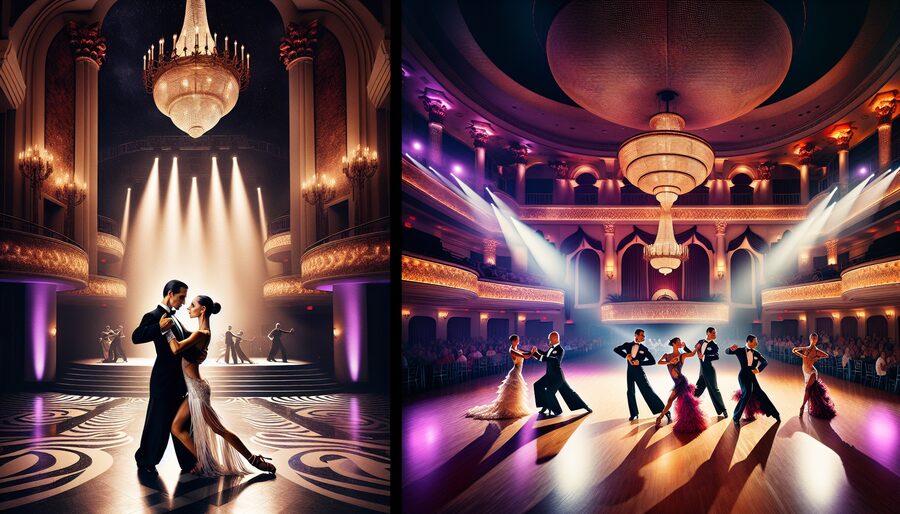
You've decided you want to learn tango. You type it into a search engine and immediately run into a problem: there are two very different dances both claiming the same name. Argentine tango and ballroom tango. They share a word, a general aesthetic of intensity, and a few surface-level similarities — and that's roughly where the overlap ends. Under the hood, they are fundamentally different dances with different histories, different structures, different music, and a completely different relationship between partners.
This isn't a trivial distinction. A student who walks into their first lesson wanting Argentine tango but ends up learning ballroom tango — or vice versa — may feel like something is off without being able to articulate why. Understanding what actually separates these two dances before you start will save you confusion, help you pick the version that genuinely matches what you're after, and set you up for faster, more satisfying progress.
Where Each Tango Comes From
Argentine tango is the original. It was born in the Rio de la Plata region — the working-class neighborhoods of Buenos Aires and Montevideo — in the late 19th century. It emerged from a mix of European immigrant music (particularly Italian and Spanish), African rhythms brought by enslaved people, and the existing gaucho culture of the pampas. Early Argentine tango was danced in the milongas (tango social halls) of Buenos Aires, where improvisation, conversation between partners, and musical interpretation were the entire point. There were no fixed syllabus steps, no judges, no standardized vocabulary — just two people responding to each other and to the music in real time.
Ballroom tango is a 20th-century European derivation. When tango swept through Paris and London in the 1910s, it was adapted to fit European social dancing conventions — which meant more upright posture, cleaner lines, and a more structured framework. By the time competitive ballroom dancing formalized its syllabus in the mid-20th century, tango had been codified into a specific set of figures, footwork patterns, and a characteristic staccato movement quality that bears only a distant family resemblance to what's danced in Buenos Aires. Today, ballroom tango exists in two competitive variants: Standard (sometimes called International or English) and American Smooth — both governed by technique manuals and judging criteria.
Understanding this history matters because it explains something fundamental: Argentine tango is a social dance and an art form. Ballroom tango is primarily a competitive and performance dance. Both are beautiful and worth learning — but they are built for different purposes.
The Embrace: The Single Most Important Difference
The hold — how the partners connect — is the most immediate and practical difference between the two dances, and it affects everything else.
Ballroom tango uses the standard closed ballroom frame: partners maintain a fixed distance, the leader's right arm wraps around the follower's back, and both partners hold their upper bodies apart from each other while maintaining a strong, structured frame. The couple moves as one unit, but there is clear space between the two bodies. The head positions in ballroom tango are characteristically dramatic — both partners turn their heads to the left (away from each other), creating the sharp, angular look associated with this style on competition floors.
Argentine tango uses the abrazo — literally "embrace" in Spanish — and it is exactly what it sounds like. Partners connect chest-to-chest, in genuine physical closeness, with the connection between their bodies serving as the primary communication channel. There is no standard head position; both partners face each other naturally. The embrace can range from an open social hold to a fully close milonguero embrace where the two bodies remain in constant contact throughout the dance. This physical closeness is not decorative — it is the mechanism by which the leader communicates direction, timing, and intention to the follower, and through which the follower interprets and responds. The connection in Argentine tango is not a style choice. It is the language.
Improvisation vs. Choreography
This is the structural fork in the road between the two styles.
Ballroom tango is taught through a codified vocabulary of figures — the promenade, the corte, the oversway, the fallaway reverse and slip pivot, and so on. Each figure has a defined entry, execution, and exit. Learning ballroom tango means building fluency in a set of established movements that can be assembled into routines or performed within competition guidelines. The sequence of steps is planned, practiced, and rehearsed. Even in social settings, ballroom tango dancers tend to draw from their learned syllabus.
Argentine tango has no fixed syllabus. Every single dance is improvised. The leader chooses from a vast vocabulary of movements — walking patterns, ochos (figure-eight foot patterns), ganchos (leg hooks), sacadas (leg displacements), boleo (leg whips), pauses, changes of direction — in real time, in response to the music, the space on the dance floor, and the follower's movement. The follower is not simply executing what the leader commands; a skilled follower adds her own embellishments, interprets the music independently within the leader's structure, and contributes to the conversation. Argentine tango is fundamentally collaborative improvisation. No two dances are ever identical.
This distinction produces very different learning curves. Ballroom tango gives beginners something to hold onto immediately: a defined sequence of steps that can be practiced and repeated. Argentine tango beginners often feel initially unmoored — there is no sequence, no set list of figures, just a walk and a connection. But what begins as disorientation typically becomes the most rewarding aspect of the dance: true improvisation between two people is something that deepens endlessly over years of practice.
Music: Two Completely Different Sonic Worlds
The music for these two styles of tango is not interchangeable — and this matters more than most beginners realize.
Argentine tango music is drawn primarily from the classic Golden Age orchestras of Buenos Aires, particularly from the 1930s–1950s: Osvaldo Pugliese, Carlos Di Sarli, Juan D'Arienzo, Aníbal Troilo, Rodolfo Biagi. The music is complex, nuanced, often melancholic, with shifting tempos, expressive pauses, and multiple distinct rhythmic "flavors" — each orchestra has a distinct character that Argentine tango dancers learn to identify and respond to differently. The music demands a different quality of movement than ballroom tango music does. More breath. More pause. More interpretation.
Ballroom tango music, by contrast, is typically more contemporary and consistently rhythmic, driven by a steady underlying beat that supports the staccato, snapping quality of the steps. International ballroom tango competitions use music specifically composed or arranged for the style. It's driving, percussive, and structurally straightforward compared to the layered complexity of a Di Sarli orchestra piece.
Which Tango Should You Learn in Palm Beach County?
The honest answer depends on what you want from the dance.
If you are interested in competitive ballroom dancing, want to perform at events or showcases, or want a dance that fits naturally alongside waltz, foxtrot, and quickstep in a standard ballroom repertoire — ballroom tango is the natural choice. It shares technique, posture, and framing principles with other ballroom dances, which means progress in one style reinforces others. The structured syllabus also gives you a clear sense of advancement.
If you are drawn to the idea of a dance as a genuine conversation — a partner activity that is improvisational, deeply connected, and endlessly variable — Argentine tango is remarkable. It also carries enormous cultural depth, a global social community (milongas are held in cities around the world, including Miami and Fort Lauderdale nearby), and a reputation as one of the most intellectually and emotionally engaging partner dances that exists. Many serious dancers who start in other styles eventually find their way to Argentine tango and never leave.
A useful practical note for South Florida: the tango community in the greater Palm Beach and Miami area skews toward Argentine tango. If you want to eventually attend tango socials, encounter other dancers, and have a community to practice with, Argentine tango gives you more local access. Ballroom tango, however, will feel more familiar in general social settings and at events where multiple ballroom dances are played.
Can You Learn Both?
Absolutely — though we'd recommend developing real fluency in one before actively pursuing the other. The two styles have enough stylistic and technical difference that mixing them too early can create confusion in your body and in your leading or following. Students who try to study both simultaneously often find that certain habits from one style bleed into the other in ways that take effort to untangle later.
The most common pathway we see in students who want both: start with ballroom tango to build general partner dance mechanics — posture, frame, weight transfer, directional movement — then transition to Argentine tango once those fundamentals are solid. The physical literacy transfers well, even as you're learning an entirely different set of conventions about the embrace, improvisation, and musical response.
Learn Tango in the Comfort of Your Own Space
At Gala Ballroom, we offer private in-home tango lessons throughout Palm Beach County — including West Palm Beach, Boca Raton, Delray Beach, Boynton Beach, Jupiter, Wellington, Palm Beach Gardens, and Lake Worth. Both Argentine tango and ballroom tango are available, and we'll tailor the approach entirely to your goals.
Private lessons mean no studio commute, no crowded floor, and no keeping up with a class that's moving at someone else's pace. You learn in your own living room, at your own tempo, with instruction focused entirely on you. It's the fastest way to build real competence — and it's a significantly more comfortable way to learn an intimate partner dance than in a room full of strangers.
Have questions about which tango is right for you? Call Gala Ballroom at (561) 523-4133 or reach out online. We'll talk through your goals and set you up with the right starting point. The tango — whichever one you choose — is waiting.