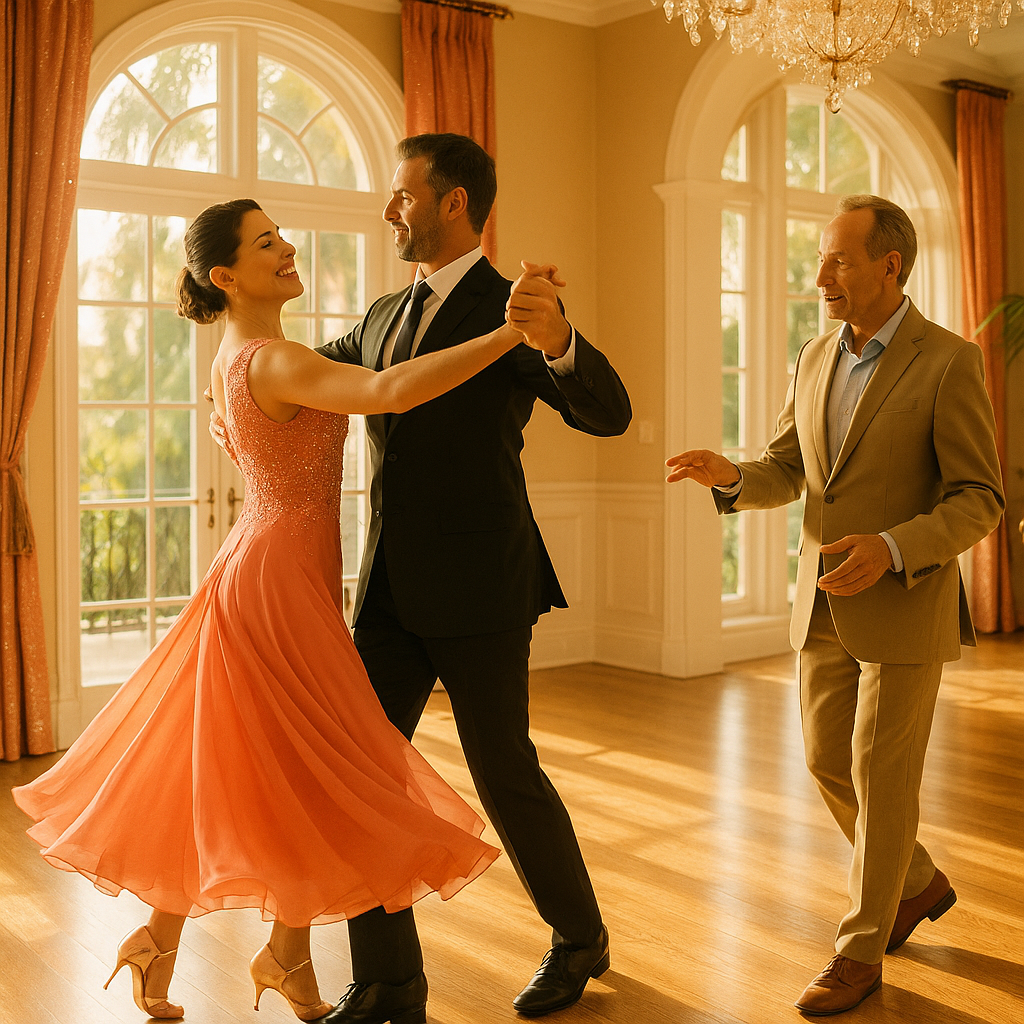
Most people think of dance as entertainment. But if you watch what actually happens in a good lesson, you’ll notice something more practical: people get steadier on their feet, more aware of their posture, and noticeably more confident in how they move.
That matters in daily life. Balance is not just for athletes or seniors. It affects how you walk across a slick driveway in West Palm Beach, how you step off a curb in Boca Raton, how you turn in the kitchen, and how confidently you carry yourself at a wedding, gala, or dinner party in Palm Beach.
At Gala Ballroom, we see it all the time. A student starts out cautious, tight, and overthinking every step. A few lessons later, they’re moving with better control, better timing, and a completely different sense of ease.
That change is not an accident. Dance trains the body and brain together.
Why Balance Starts in the Brain, Not the Feet
Balance is often described like it’s purely physical, but it’s really a coordination problem. Your brain has to process where your body is, where the floor is, where your weight is shifting, and what comes next. Every step in dance gives that system a workout.
When you learn a Waltz, Salsa, Rumba, or Foxtrot, you are constantly practicing three things at once: weight transfer, timing, and spatial awareness. That combination is powerful because it forces the brain to create cleaner movement patterns instead of relying on habit.
Research has increasingly shown that dance interventions can improve balance, mobility, and quality of life in older adults. A 2024 systematic review and network meta-analysis in Frontiers in Public Health found that dance interventions can reduce fall risk, and another meta-analysis reported meaningful balance gains across multiple dance styles. In plain English, dance is not just graceful. It is functional training disguised as something beautiful.
What Makes Dance So Effective for Coordination?
1. It trains controlled weight shifts
Most people do not consciously practice moving their weight from one leg to the other. Dance does. That matters because balance is built on controlled transitions, not stiff stillness. The more you practice shifting smoothly, the less likely you are to feel wobbly in real life.
2. It improves reaction time
In a lesson, you are constantly adjusting to music, rhythm, and guidance. That means your nervous system is learning to respond faster. You hear the cue, feel the beat, and correct your body in real time. That kind of responsiveness carries over to everyday movement.
3. It strengthens posture naturally
Good dance technique asks for a tall spine, engaged core, and relaxed shoulders. That posture is not just aesthetic. It improves alignment, which can make walking, turning, and standing feel easier and more stable. People in South Florida often come to us for the dance, then realize their posture improves everywhere else too.
4. It challenges the brain with rhythm
Rhythm is where the real magic happens. The brain loves patterns, but it has to work to stay synced with music while the body moves. That dual tasking is one reason dance can be so effective for coordination and cognitive engagement. You are not just repeating steps, you are learning to predict, adapt, and stay present.
Why In-Home Lessons Make This Even Better
There is a huge difference between practicing balance in a crowded studio and doing it in your own space with private instruction. In your home, you can focus on the movement instead of worrying about traffic, parking, mirrors, or strangers watching you.
That comfort matters. When people feel self-conscious, they tend to move too rigidly. Tight muscles, shallow breathing, and hesitation all make balance worse. In a private lesson at home, the nervous system settles down faster, which makes learning more efficient.
We also see better follow-through this way. If your lesson happens at home in Palm Beach Gardens or Wellington, it is easier to stay consistent. There’s no commute excuse, no lost momentum, and no stress spike before class. You practice more, so you improve more.
Confidence Is Part of the Health Benefit
People often underestimate this part. Balance is not just about avoiding a fall. It’s about trusting your body again.
When someone feels unsteady, they naturally start moving smaller and more cautiously. They avoid certain steps. They hesitate on stairs. They stop dancing at events because they do not feel sure of themselves. That shrinking effect can spill into confidence in general.
Dance reverses that. Each lesson gives you a small win: a cleaner turn, a steadier step, a better frame, a smoother lead or follow. Those wins add up. The body becomes more capable, and the mind follows.
That is why so many adults tell us they did not expect dance to affect how they carry themselves in the rest of life. But it does. Better balance changes your posture, and better posture changes how you feel walking into a room.
Who Benefits Most From Dance-Based Balance Training?
Pretty much everyone, but some groups notice it faster than others.
Adults returning to movement: If you have been inactive, dance gives you a structured way back in without feeling like a gym routine.
Couples: Partner dancing adds shared timing and trust, which improves coordination and connection at the same time.
Older adults: Dance challenges balance, gait, and attention in a way that feels enjoyable instead of clinical.
Event clients: If you want to look natural at a wedding, gala, or party, a few lessons make a big difference in how comfortably you move in formal spaces.
What We Teach First
We never rush people into big patterns before they can control the basics. The foundation is simple:
- standing with relaxed alignment
- finding the center of gravity
- transferring weight cleanly
- learning to breathe while moving
- matching movement to rhythm instead of forcing it
Once those pieces are in place, the dancing starts to feel easier almost immediately. That is when confidence grows.
The Bottom Line
Dance is one of the rare activities that improves balance, coordination, posture, rhythm, and confidence all at once. It gives your brain a reason to stay alert and your body a reason to stay adaptable. And when you learn at home, the process becomes even more comfortable and sustainable.
If you live in Palm Beach County, West Palm Beach, Boca Raton, Delray Beach, Jupiter, Wellington, or nearby South Florida areas, private lessons can help you move better for the moments that matter most, from everyday life to unforgettable events.
Ready to feel steadier and more confident on your feet? Explore our private lessons, learn about our performances, see our live violin options, or contact Gala Ballroom to book.
Call (561) 523-4133 and let’s get you moving with more balance and ease.