Please note: this article is general information, not medical advice. If you have arthritis or joint pain, check with your doctor or physical therapist before starting any new activity.
If you live with arthritis or chronic joint pain, you've probably been told the same thing: stay active, keep moving, don't let the joints stiffen up. The advice is sound. The hard part is finding movement that actually feels good, exercise that doesn't punish the very joints you're trying to protect.
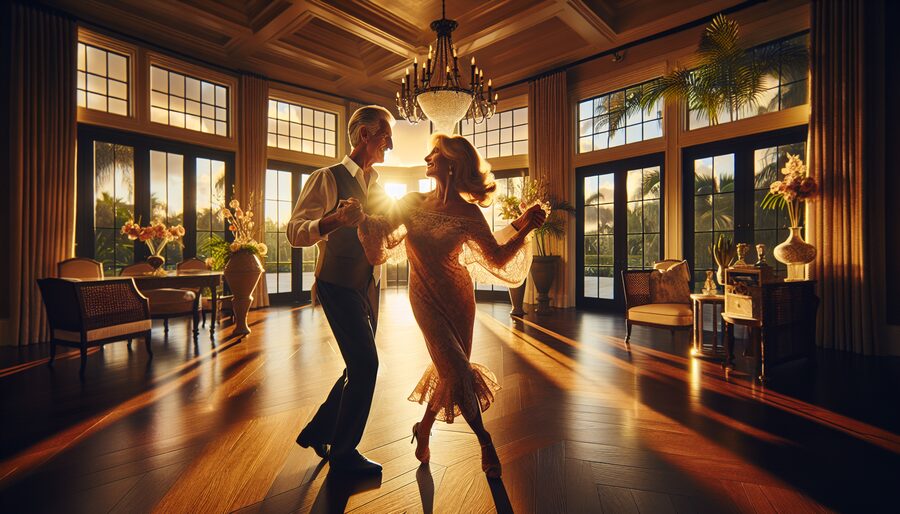
Swimming is often recommended. Walking is fine. But for many people in Palm Beach County living with osteoarthritis or age-related joint stiffness, there's another option worth asking about: gentle ballroom dancing.
Joint pain and dancing don't sound like they belong in the same sentence. But a growing body of research on dance-based exercise, along with guidance from arthritis organizations, suggests that the right kind of dancing, done at the right pace, can be a comfortable and enjoyable way to stay active.
What the Research Says
The Arthritis Foundation includes dance-based fitness among the activities people with arthritis can consider, noting that dance can help with coordination, balance and cardiovascular fitness when it's modified for the individual.
One of the better-known studies comes from researcher Jean Krampe and colleagues, published in Geriatric Nursing. Older adults with hip or knee pain, most of it caused by arthritis, took part in a gentle dance-based program for 12 weeks. The dancers reported less pain and walked faster, and they cut their use of pain medication by 39 percent, while the group that didn't dance used 21 percent more. It was a small study of 34 people, so it's encouraging rather than conclusive.
The broader picture is clearer for exercise in general. A 2015 Cochrane review of 44 trials found that therapeutic exercise reduced pain and improved physical function in people with knee osteoarthritis, and that individually delivered programs appeared to bring greater improvements. Dance is one enjoyable way to get that kind of regular, gentle movement, and people are more likely to keep doing something they look forward to.
Why Dance Can Work When Other Exercise Doesn't
Arthritic joints can get caught in a frustrating cycle. Pain leads to less movement. Less movement leads to weaker muscles around the joint. Weaker muscles give the joint less support, which can make it feel worse, and the cycle continues.
Breaking that cycle calls for movement that is gentle enough to tolerate but purposeful enough to keep the muscles around the joint working. Slow, guided partner dancing can fit that description. Consider what happens in a basic waltz or slow foxtrot:
- The gliding footwork is lower-impact than running or jumping, while still being weight-bearing movement, the kind generally encouraged for bone and muscle health.
- Slow, controlled turns move the hips and knees through a comfortable range of motion while you're also working on balance and coordination.
- The posture of partner dancing (holding a frame, engaging the core, lengthening the spine) gently works the muscles of the back and hips that tend to weaken with long periods of sitting.
- The music matters too. Many people find that moving to music they enjoy makes activity feel easier, and research on music and pain (below) suggests why.
None of this happens in isolation. It happens together, in a continuous flowing movement that uses the whole body without asking too much of any one joint. That's what separates social dancing from repetitive exercises that can feel more like a chore than a pleasure.
The Music Connection
Pain isn't simply a signal from a joint. It's an experience shaped by the brain, which is why attention, mood and context can change how much something hurts.
Music is one of the things that seems to help. Listening to music people enjoy triggers dopamine release in the brain's reward system, according to a study from McGill University. A 2017 review of 14 randomized trials in Pain Physician found that music reduced self-reported chronic pain and depressive symptoms, and that the effect was larger when people chose their own music. That fits nicely with private lessons, where you pick the songs.
Which Dance Styles Are Gentlest on the Joints?
Not every ballroom dance asks the same of your joints, and a good instructor will help you choose a starting point that suits you. Some general principles:
The Waltz is often a good place to start. Its slow tempo, around 84 to 90 beats per minute, gives you time to settle into each step, and the gentle rise and fall moves the ankles, knees and hips through a comfortable arc. Holding the frame also works the shoulders and upper back.
The Foxtrot shares the waltz's smooth, gliding quality, and its basic footwork is close to an elegant walk. For people with hip or knee arthritis who want to build confidence before trying turns, it's a natural entry point.
The Rumba, the slowest of the Latin dances, involves a gentle side-to-side hip action at an unhurried pace, and it can be scaled down to whatever range of motion feels comfortable.
Cha-Cha adds livelier footwork. It can be danced with small, low-impact steps for anyone who wants more energy without jumping or sudden direction changes.
The most important variable is good guidance. An instructor who watches how you move, keeps steps within a comfortable range, and adjusts on the spot makes a real difference, and anything that hurts should be skipped or modified.
The In-Home Advantage When You're Managing Pain
For anyone dealing with joint pain, the logistics of getting to a dance studio (the drive, the parking, the hard studio floors, a room full of strangers) can be enough to stop them from ever starting. Often the barrier isn't the dancing. It's everything around it.
Gala Ballroom's private in-home lessons remove much of that. Depending on location and availability, your instructor comes to your home in Palm Beach County, and you dance on your own floor, at a pace that suits your body on that particular day.
There's no performance pressure, no mirror wall, no keeping up with a group class. If something feels wrong, you stop and the lesson adjusts. If you're recovering from surgery or going through a flare, talk to your doctor or physical therapist first, and share any guidance they give you so the lessons can follow it.
More Than an Exercise Routine
Studies can measure things like pain scores, walking speed and balance. They can't easily capture the feeling of moving gracefully again, the moment when a body that has felt limiting becomes, for a few minutes, a source of pleasure.
People who dance with arthritis often describe a shift in how they relate to their bodies. The pain is still real, but there's also the discovery that the body can still do something beautiful.
If you or someone you love is managing arthritis or joint stiffness and your doctor has given the go-ahead for gentle activity, reach out to Gala Ballroom. Tell us what's comfortable, what's limited and what you'd like to be able to do, and we'll talk through whether private lessons are a good fit.
The best movement is movement you'll actually do. And dancing, it turns out, is something people actually want to do.