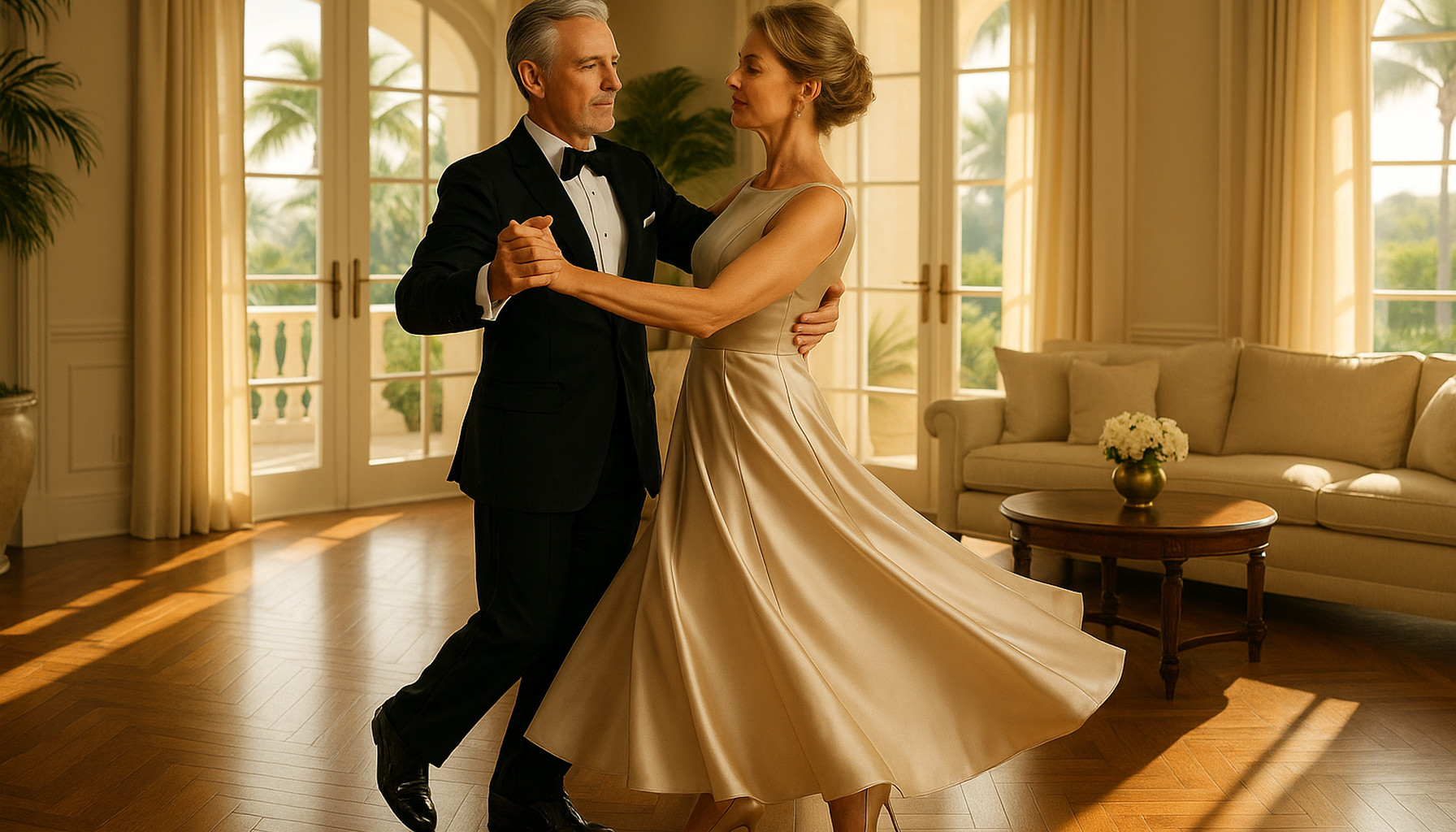
Turning is one of those everyday movement skills people do not think about until it starts feeling different. Maybe it happens when you pivot away from the kitchen counter in West Palm Beach, turn around in a restaurant in Boca Raton, or step out of the car and notice you want an extra second to organize yourself before walking.
That is why so many adults in Palm Beach, Delray Beach, Jupiter, and across South Florida are not really looking for a random workout. They are looking for movement that helps real life feel easier. Ballroom dance can be surprisingly useful here because it does not just train strength in isolation. It trains posture, directional control, weight transfer, rhythm, balance, and confidence all at once. For people who want to feel steadier when they turn, that combination matters.
Why turning feels harder before many people notice bigger mobility changes
Turning asks more of the body than walking forward in a straight line. You have to shift weight cleanly, control momentum, organize the feet under the body, and keep your center from drifting too far outside your base of support. Vision helps. Timing helps. Calmness helps. If any of those pieces feel slightly off, turning can start to feel rushed, stiff, or uncertain.
That is one reason people often notice discomfort with turning before they notice major limitations elsewhere. Walking across a room may still feel fine, but pivoting around a chair, changing direction in a hallway, or turning to greet someone at a party can feel subtly less secure. Many adults compensate without realizing it by tightening their shoulders, shortening steps, or moving more cautiously than they used to.
The issue is not always raw strength. Often it is coordination. The body has to know when to release, when to step, where to place the foot, and how to keep the upper body from becoming rigid. That is exactly where ballroom dance has practical value.
Ballroom dance teaches controlled direction changes, not just pretty steps
A thoughtful dance lesson constantly works on the mechanics that make turning smoother. You learn how to move your weight fully instead of hovering between feet. You practice stepping under your body instead of reaching too far. You organize posture so the turn begins from a stable center rather than from panic or momentum. Even simple side steps, quarter turns, and walking patterns start training the body to change direction more efficiently.
That is a big reason private dance instruction feels different from generic exercise. Instead of repeating one motion on a machine, you are teaching the body how to respond in motion. Ballroom movement develops timing, foot awareness, and controlled rotation while staying graceful and low impact. For many people, it also feels more enjoyable than clinical drills, which makes them more likely to stay consistent.
Consistency matters. A movement plan only helps if it becomes something you actually want to keep doing. That is one of the advantages of private dance lessons at home or in a comfortable one-on-one setting. The work is tailored, the pace is realistic, and the progress feels personal instead of generic.
What the current research supports
It is important to stay honest here. Ballroom dance is not a medical cure, and it would be irresponsible to promise that one lesson will erase turning difficulty. But the research behind dance and functional mobility is stronger than many people realize.
A 2024 systematic review in PLoS One looked at 16 studies involving dance interventions for middle-aged and older adults and found that most reported improvements in physical function, balance, postural control, and quality of life. The authors also noted a high level of adherence compared with several other exercise or rehabilitation approaches. That point matters because the most effective plan is often the one people will actually continue.
A separate 2024 network meta-analysis in Frontiers in Public Health examined 27 studies involving 1,219 older adults. It found that dance interventions improved balance measures and Timed Up and Go performance, and ballroom dance was among the forms that improved Timed Up and Go compared with controls. Timed Up and Go includes standing up, walking, turning, and sitting back down, so it captures several of the same ingredients people rely on in everyday directional changes.
There is also a useful practical lens here. The CDC's STEADI fall-prevention framework emphasizes gait and balance because those basics shape how people move through daily life. Dance is not the only way to train them, but it is one of the few methods that blends gait, rhythm, attention, posture, and enjoyment in the same session.
The clean takeaway is this: the evidence is strongest for balance, mobility, and movement confidence, not for dramatic promises. But those are exactly the building blocks people need when turning has started to feel less natural.
Why private lessons are especially helpful for this goal
If turning confidence is one of your concerns, a crowded studio class is usually not the ideal starting point. Too much visual noise, too much comparison, and too much speed can make people brace instead of improve. Private instruction allows the lesson to stay focused on quality. The pace can slow down when needed. Small corrections can happen immediately. And the material can fit the body in front of the instructor instead of the average of a group.
That might mean spending time on calmer walking patterns, cleaner weight transfers, easier turns, and better use of the standing leg before adding anything more complex. Those details are not flashy, but they are often what make daily movement feel smoother again.
Many clients first meet Gala Ballroom through our performances or live violin work at South Florida weddings and private events. What surprises them is how well the same elegance translates to practical movement training. Dance does not only belong on a stage or at a celebration. It can also be one of the smartest ways to rebuild trust in how your body moves.
What improvement usually looks like in real life
Progress here is often quiet before it becomes obvious. First, you may notice that you are not rushing your turns as much. Then your foot placement gets cleaner. Then you realize you are pivoting around furniture, turning in narrow spaces, or walking through a busy room with less hesitation. That is meaningful progress because it shows up where life is actually happening.
Of course, if you have frequent dizziness, a recent fall, vertigo, or a medical condition affecting balance, it is smart to speak with a healthcare professional first. But for many adults in Palm Beach County, dance can be a low-impact and sustainable way to improve the kind of control that everyday life keeps asking for.
If turning has started to feel stiffer, slower, or more uncertain than it used to, that is not something you have to ignore. A well-taught private lesson can build balance, coordination, and calm confidence in a way that feels warm, elegant, and realistic. Call (561) 523-4133 or contact Gala Ballroom here to get started.