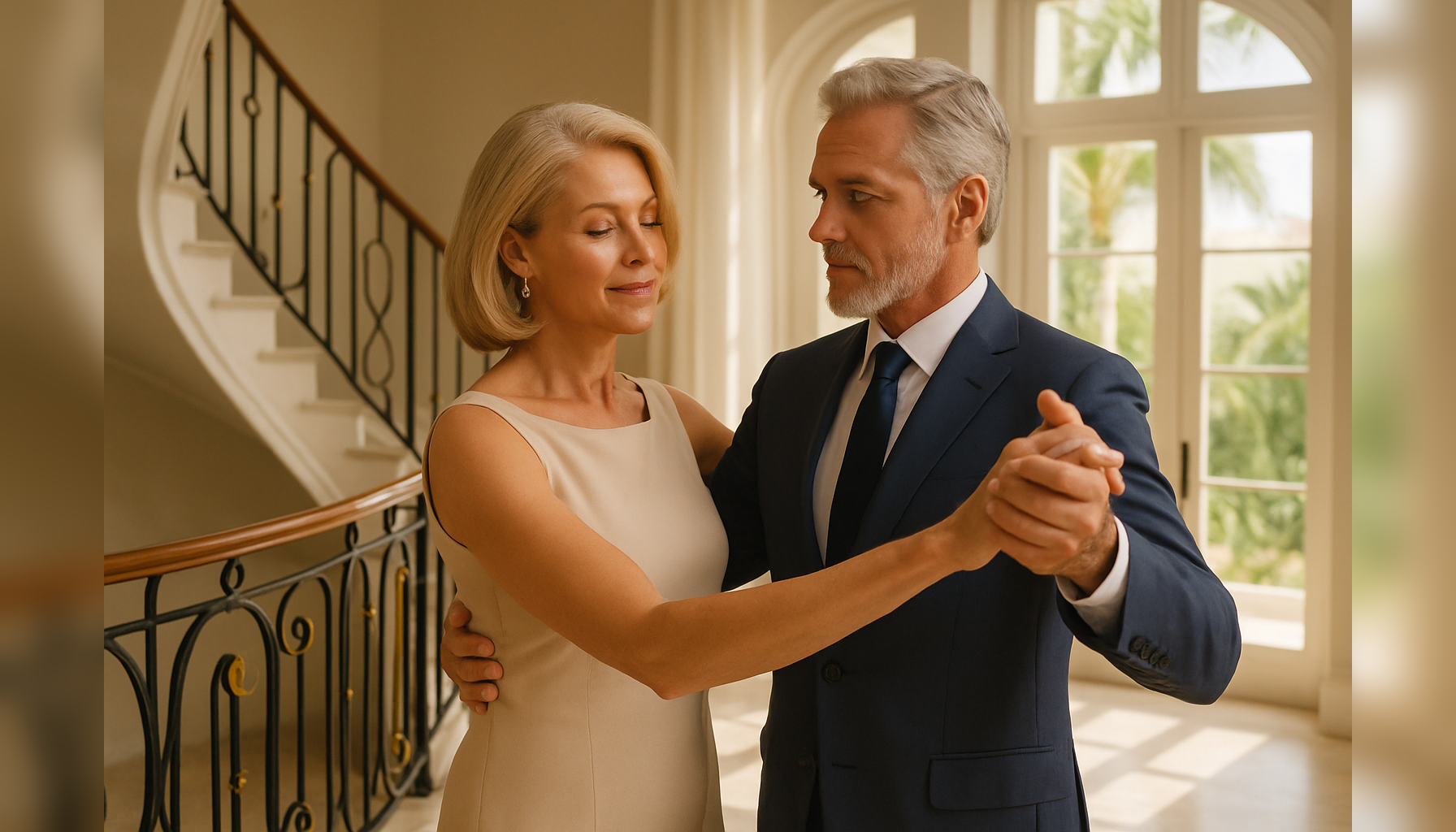
People rarely talk about stairs until stairs start feeling different. It might be one extra pause before walking down from a country club terrace in Palm Beach. It might be a little hesitation at a hotel staircase in Boca Raton, or that quiet instinct to grab the rail sooner than you used to. For many adults, those moments matter more than any number on a fitness app because they show up in real life.
That is also why more people ask a smarter question than What workout should I do? They ask, What kind of movement will actually help me feel steadier? Ballroom dance is one of the strongest answers because it does not just train muscles in isolation. It trains balance, timing, controlled weight transfer, posture, attention, and confidence at the same time. For adults in Palm Beach, West Palm Beach, Delray Beach, Jupiter, and across South Florida, that combination can be surprisingly useful when stairs start feeling less automatic.
Stair confidence is about more than strong legs
When people feel uncertain on stairs, they often assume the problem is only strength. Strength matters, but it is only one part of the picture. Going up and down stairs also requires single-leg balance, controlled lowering, foot placement, coordination, trunk control, and the ability to stay calm while your body changes levels and direction.
That is why someone can feel reasonably fine walking across a flat room and still feel a little cautious on steps. Stairs ask the body to organize itself quickly. You have to shift weight cleanly, trust one leg at a time, keep posture from collapsing, and react if the rhythm feels off. If confidence has already slipped a little, the stairway is often where people notice it first.
Ballroom dance trains the same movement skills stairs demand
A good ballroom lesson does not look like stair training, but many of the underlying skills overlap beautifully. You step and collect. You rise and lower with control. You transfer weight without rushing. You organize the feet underneath the body. You turn while keeping your center stable. You learn how to move without bracing.
That matters because stairs are rarely just a leg exercise. They are a rhythm-and-control exercise. The body needs to know where it is in space, how to place the next foot, and how to manage the shift without panic. Ballroom dance builds that awareness in a way that feels elegant rather than clinical. Instead of drilling isolated repetitions, you are practicing whole-body control in motion.
For many adults, that is exactly why dance works better than routines they abandon after two weeks. It feels purposeful. It feels social. It feels mentally engaging. And because it is enjoyable, people tend to stay with it long enough to actually improve.
What the research actually supports
It is important to be precise here. Ballroom dance is not a medical treatment, and no honest instructor should promise that one lesson will solve stair anxiety. But the research around dance and mobility is genuinely encouraging.
A 2024 systematic review in PLoS One looked at 16 studies on dance interventions in middle-aged and older adults and found that most showed improvements in physical function, balance, postural control, and quality of life. The same review also noted that dance programs often had better adherence than physiotherapy, self-care programs, or standard exercise approaches, which matters because the best movement plan in the world does not help much if people do not stick with it.
A separate 2024 network meta-analysis in Frontiers in Public Health examined 27 studies involving 1,219 older adults and found that dance interventions improved balance measures and Timed Up and Go performance, with ballroom dance among the effective forms. Timed Up and Go is relevant because it includes standing, walking, turning, and sitting back down. That is not identical to stair use, but it measures many of the same ingredients people need to feel safer going up and down steps: controlled transitions, balance in motion, and confidence during direction changes.
So the honest takeaway is not that dance magically “fixes stairs.” It is that dance improves the physical and coordination skills that make stairs feel more manageable in daily life.
Why private lessons can be especially helpful
If your goal is everyday confidence, private instruction often makes more sense than jumping into a busy studio floor. A crowded class can be noisy, distracting, and too fast for someone who wants to work carefully on balance, posture, and calm movement. In a private lesson, the pace can stay realistic. The focus can stay on quality. And the instruction can adapt to what your body actually needs.
That may mean building steadier walking patterns, cleaner turns, better posture, gentler lowering through the legs, or more trust in your foot placement. Those details matter. They are also easier to absorb in a one-on-one setting where you are not trying to keep up with strangers or pretend you feel more comfortable than you do.
Many clients first discover Gala Ballroom through our performances or live violin work at South Florida events, then realize the same elegance can support how they move in everyday life too. That bridge matters. Dance does not have to be only for weddings, parties, or formal events. It can also be one of the most enjoyable ways to feel more capable in your own body.
How to think about dance if stairs are one of your concerns
If you want dance to support better stair confidence, the goal is not flashy choreography. The goal is fundamentals. Stronger posture. Cleaner weight shifts. Better use of the feet. Controlled lowering. Smoother transitions. Calm turning. Reliable rhythm. Those basics carry far beyond the dance floor.
It also helps to start with realistic expectations. Improvement usually feels gradual before it feels dramatic. First, you notice that turns feel less rushed. Then you notice cleaner foot placement. Then maybe you realize you are moving through a restaurant, patio, or front steps with less internal negotiation than before. That is meaningful progress.
If you have had a recent fall, significant dizziness, or a medical condition affecting balance, it is smart to get medical guidance first. But for many adults in Palm Beach County, structured dance can be a low-impact, enjoyable, and genuinely practical way to build the kind of control that everyday life rewards.
If stairs have started feeling more annoying, more awkward, or more mentally loud than they used to, that is not something to ignore. It is also not something you have to answer only with machines or repetitive exercises. A thoughtful private lesson can build balance, leg control, and movement confidence in a way that feels warm, polished, and sustainable. Call (561) 523-4133 or contact Gala Ballroom here to start.