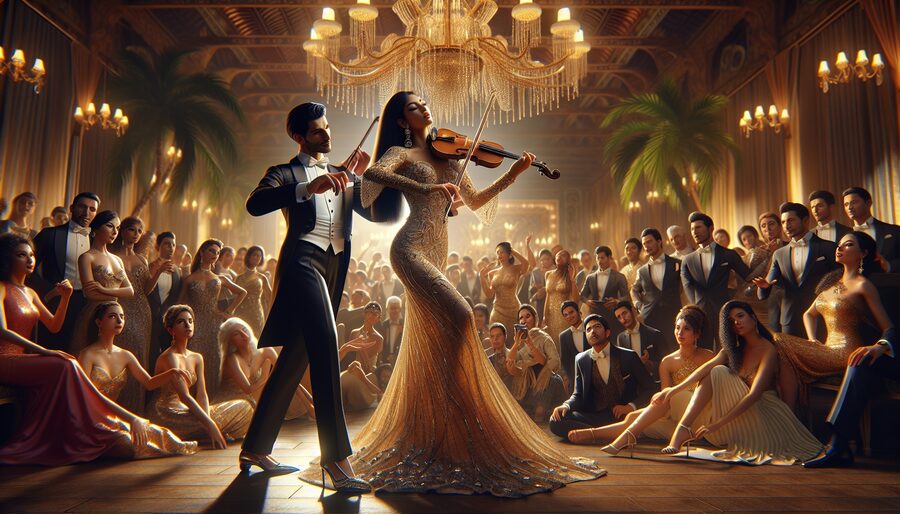
There's a predictable moment at most events. The cocktail hour wraps up, the guests filter into their seats, and somewhere between the salad course and the speeches, a subtle thing happens: the room becomes something people are attending rather than something they're inside of. The energy settles. The conversations get quieter. People are politely present, but they've mentally moved on.
Then, on the right night, something else happens instead. A bow meets a string. A dancer steps onto the floor. The room shifts — and stays shifted. Guests stop checking their phones. Strangers start talking to each other. The couple at the center of it all sees their friends lean forward, watching. And by the end of the night, the conversation isn't about the venue or the food or the decor. It's about that moment.
Understanding why that shift happens — what's actually occurring neurologically and socially when live performance enters a room — helps explain why so many hosts in Palm Beach County, West Palm Beach, and Boca Raton who've tried it once never go back to a DJ-only setup.
The Neuroscience of Live vs. Recorded
It would be easy to dismiss the preference for live performance as sentiment — a vague feeling that "live is better" without much substance behind it. But the research suggests something more specific is happening, and it starts in the auditory cortex.
When the human brain processes live music versus recorded music, different neural pathways activate. A 2019 study out of the University of Toronto measured neural responses to identical musical pieces performed live versus played from a recording in the same acoustic space. Participants showed significantly stronger activation in the limbic system — the brain's emotional processing center — during live performance, even when they couldn't visually see the performer. The mere knowledge that a human being was producing the sound in real time changed how the brain responded to it.
Part of this is mirror neuron activation. When you watch a skilled performer — a violinist drawing a long, expressive phrase out of a string, a dancer shifting their entire center of gravity into a turn — your mirror neurons fire as though you were performing those movements yourself. You feel a subtle version of what the performer is doing in your own body. That physical empathy is unavailable when you're listening to a speaker. It only happens when there's a human being making something in front of you.
The result is that live performance doesn't just sound or look better. It is neurologically experienced differently — more emotionally, more physically, more memorably. Guests' brains process it as a shared human event rather than ambient content, and that distinction is encoded differently in long-term memory.
Why the Combination of Violin and Dance Amplifies the Effect
Solo performance creates a focal point. But the combination of live violin and ballroom dance does something more complex: it creates a visual-auditory narrative that draws people in on multiple levels simultaneously.
Music and movement evolved together in the human brain. Rhythm processing and motor planning share neural circuitry — which is why you instinctively want to tap your foot when you hear a beat, and why watching a skilled dancer move to music produces a stronger emotional response than watching either the dancer or the musician alone. The two art forms are neurologically complementary in a way that magnifies the impact of each.
When guests watch live violin paired with professional ballroom dance, they're experiencing a form of synchronized artistry that engages auditory processing, visual tracking, emotional response, and physical empathy all at once. The brain is working harder and feeling more simultaneously. That's not exhausting — it's the state that humans find most absorbing. It's attention without effort. Flow without work.
The genre versatility of the combination matters too. A skilled violin-and-dance duo can move through classical, contemporary, Latin, and cinematic repertoire in a single evening — matching the emotional arc of your event rather than flattening it with a uniform playlist. A ceremony entrance feels sacred. A cocktail hour feels festive. A first dance becomes cinematic. The same two performers, the same instruments — just the music and movement shifting to serve the moment.
What Happens to a Room When Live Performance Enters It
Event planners and hosts throughout South Florida consistently describe the same progression when live performance is part of the program. The first response is attention — conversations stop mid-sentence. Then comes what social psychologists call "social facilitation": guests who were talking only to the people at their table begin to make eye contact with strangers across the room, sharing reactions. Then, as the performance continues, a sense of shared experience settles over the room — the particular warmth of being present for something together that feels unrepeatable.
That warmth doesn't dissipate when the performance ends. Research on collective effervescence — the social bonding that occurs through shared experiences — shows that people who witness the same emotionally resonant event together report stronger interpersonal connection afterward, even with strangers. Your guests leave your event not just having been in the same room, but having felt something together. That's the difference between a gathering and an experience.
For weddings specifically, this effect compounds. The couple's guests become a room that experienced something, not just attended something. The conversations on the way home aren't "nice wedding" — they're "did you see that?" That emotional residue is what turns an event into a story guests tell for years.
The Cocktail Hour Question
If there's one moment where hosts consistently underinvest in entertainment, it's the cocktail hour. This is actually the most important social window in any event: guests are standing, moving, choosing who to talk to, forming their first impressions of the evening and of each other. The atmosphere in this window sets the tone for everything that follows.
Background music — even excellent background music — does something to a cocktail hour. It signals to guests that this is a waiting period, a transitional moment before the main event. Live violin does something entirely different: it signals that the event has already begun, that something worth paying attention to is already happening, and that the evening is going to be worth being fully present for.
The violin is particularly well-suited to cocktail hours because it has the tonal warmth and projection to fill a room without dominating conversation — unlike brass or amplified instruments that can make people feel they have to compete to be heard. A skilled violinist playing elegant, ambient repertoire creates an acoustic atmosphere that is simultaneously beautiful and social-forward. Guests relax faster. Conversations start more easily. The energy that builds in a well-scored cocktail hour carries into the dinner, the toasts, the first dance, and everything that follows.
Engagement That Extends Beyond the Performance
One of the things that distinguishes live performance from other entertainment forms is what it makes possible in the room beyond the performance itself.
When guests watch professional ballroom dancing, something interesting happens on the dance floor later in the evening: people who might not have danced actually dance. Seeing skilled, joyful movement creates permission and aspiration — it makes dancing feel like something that's happening here tonight, not something that requires a certain kind of person or a certain level of skill. The floor opens up in a way that doesn't happen when a DJ has been providing the only movement cues all night.
This is particularly true for the couple's first dance. When professional dance is part of the evening's entertainment, the first dance doesn't feel isolated or performative — it's part of a continuum of movement that the room is already emotionally invested in. Guests watch it differently. The couple feels it differently.
For events in Palm Beach Gardens, Jupiter, Wellington, Delray Beach, Boynton Beach, and Lake Worth, this cultural accessibility matters. South Florida has a vibrant Latin dance tradition and a long history of ballroom culture. Live performance that includes professional ballroom dance speaks to that tradition and meets guests where they already are emotionally — particularly for events that include multi-generational guest lists.
What to Ask When You're Booking
Not all live performers are the same, and not all performance packages fit the same event. When you're evaluating entertainment for a Palm Beach County event, the questions worth asking include: Can they adapt their repertoire to match different moments in your event? Do they have experience performing in your venue's acoustic environment? Can the violinist and dancer work together as a cohesive act rather than two separate performers sharing a stage? And — practically — how much space do they need?
Our team at Gala Ballroom has performed at events of every scale throughout Palm Beach County, from intimate private dinners to large gala fundraisers. We work with couples and event hosts from the beginning of the planning process to ensure the performance serves your vision — which moments you want elevated, which you want understated, and how the energy should move through the evening.
If you're planning a wedding, a private celebration, a corporate event, or a milestone gathering in South Florida and you want the kind of entertainment that guests actually remember, we'd love to talk through what's possible for your specific event. The combination of live violin and professional ballroom dance is genuinely one of a kind in this region — and the difference it makes to a room is something you have to experience once to fully understand.
Reach us at (561) 523-4133 or visit our performances page to learn more about what we offer. You can also explore our live violin services for ceremonies and cocktail hours, or get in touch directly to start planning.