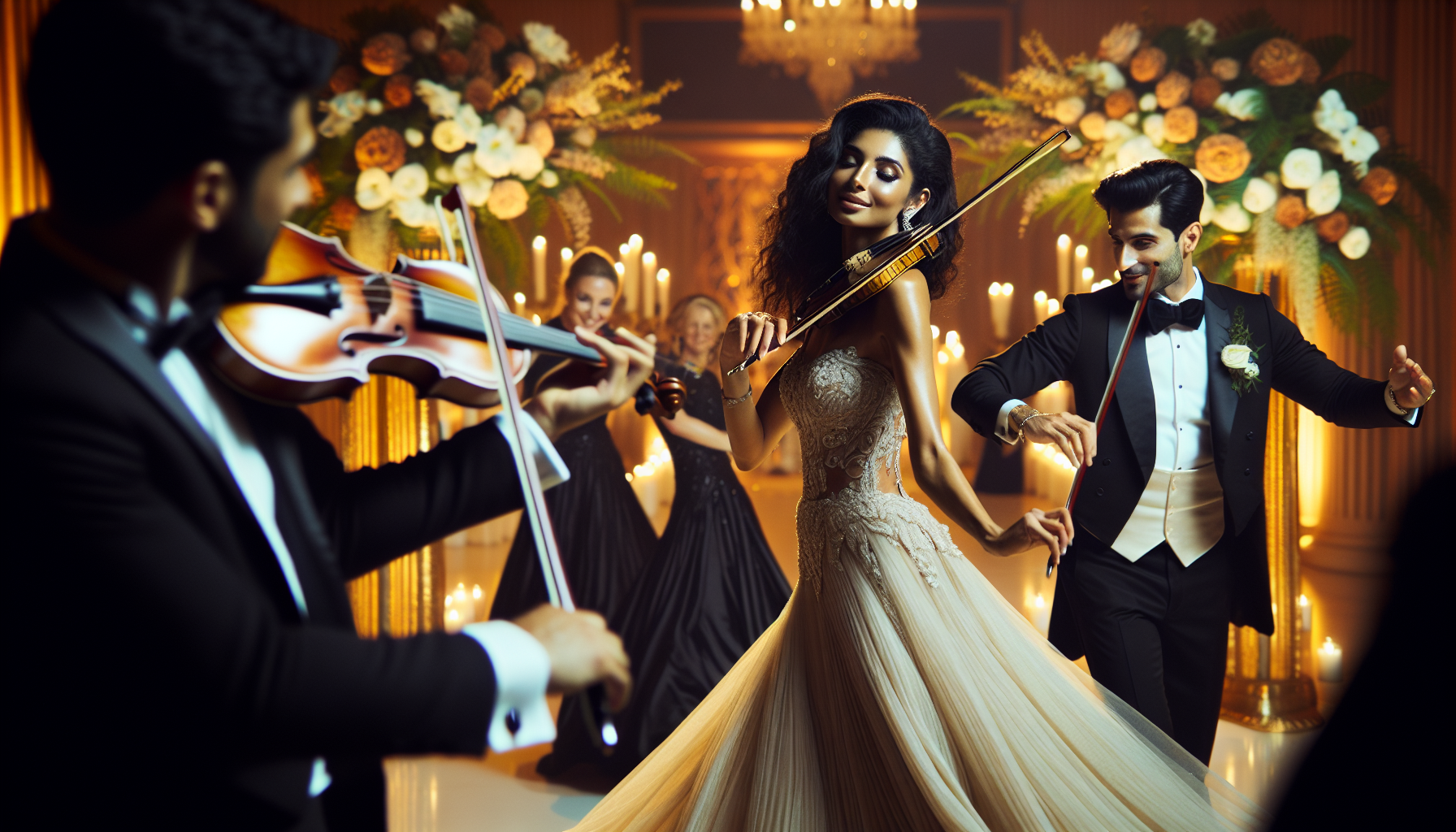
Your wedding guests will remember three things about your reception: the way it felt, the people they shared it with, and the music that played while it all happened. If you're relying on a DJ or a Spotify playlist, you're missing something neuroscientifically profound. Live music—especially live violin—doesn't just create a better atmosphere. It literally changes how your guests' brains encode memories, process emotion, and engage with the moment.
This isn't subjective. This is neurobiology. And understanding it might be the most important decision you make about your wedding day.
The Memory Encoding Difference: Why Live Music Sticks
When your brain encodes a memory, it doesn't record events like a video camera. It processes them through multiple sensory streams simultaneously—what neuroscientists call "multimodal encoding." Live music activates all of these streams at once in a way recorded music fundamentally cannot.
A study published in Nature Neuroscience by researchers at UC Berkeley examined neural activity during live versus recorded musical performance. When participants listened to live music, their brain regions coordinated across auditory cortex, prefrontal cortex, and emotional processing centers (amygdala and insula) in dramatically tighter synchronization than during recorded music playback. More remarkably, the brains of the performer and the listener showed synchronized neural activity—what scientists call "brain-to-brain coupling." Your guest's neural firing patterns literally sync with the violinist's in real time.
This synchronization doesn't happen with recordings. A pre-recorded track comes from a fixed, past source. Your brain processes it as information arriving at you. Live performance creates a temporary network—performer and audience become a single coupled system. The memory encoded during live music includes this coupling, making it richer, more deeply embedded, and more emotionally weighted.
For wedding guests at ceremonies in Palm Beach, Boca Raton, Delray Beach, or anywhere in South Florida, this means the difference between "that was nice music" and "I'll remember that moment for the rest of my life."
The Unpredictability Factor: Why Live Matters More Than Perfect
Brains pay more attention to novel and unpredictable stimuli. It's called the "predictive coding" model of perception, and it explains something counterintuitive: a slightly imperfect live performance captures your brain's attention more completely than a flawlessly mixed recording.
When you know exactly what's coming—because you've rehearsed a playlist to perfection—your brain's prediction circuits fully anticipate the next beat, the next transition, the next phrase. This reduces the predictive error signal, which means less attention, less emotional engagement, and weaker memory encoding. Your brain has already simulated what will happen, so it doesn't need to process it as fully.
Live performance introduces controlled unpredictability. The violinist might add a small flourish here, adjust phrasing there, respond to the energy of the moment in ways no algorithm can replicate. Your brain constantly predicts what comes next, and constantly encounters small surprises that violate those predictions—in exactly the way that generates maximum engagement and memory strength.
Research on attention and memory, published in Psychological Bulletin, found that events with moderate unpredictability generate 40% stronger memory encoding than fully predictable sequences. The brain doesn't want a perfect performance. It wants a live one.
Emotional Resonance and the Primacy of the Real
There's something your mind knows instantly when music is coming from a human being in front of you rather than a speaker. That knowledge shapes everything about how you experience it.
When you see someone create beauty in real-time—a violinist drawing their bow across strings, the sound waves traveling through air to your ear, your body feeling the physical vibration—your emotional response is categorically different from listening to a recording. Neuroscientists at McGill University have documented this: live musical performance triggers significantly greater oxytocin release (the neurochemical associated with bonding and trust) and dopamine release (motivation and reward) compared to hearing the same music recorded and played back.
At a wedding in West Palm Beach or Jupiter, this matters viscerally. Your guests aren't just listening to nice violin music during the ceremony—their bodies are biochemically aligning with the experience in ways that deepen their emotional investment in your marriage, their sense of connection to each other, and their memory of the event.
A DJ playing "Pachelbel's Canon" through speakers is music. A violinist playing it live in the same room creates an experience. Your guests' bodies know the difference before their minds do.
The Social Synchronization Effect
Humans are synchronized creatures. When we experience music together—especially live music—our bodies literally synchronize. Heart rates align. Breathing aligns. Neural oscillations align. This is called "social synchrony," and it's one of the most profound mechanisms for building group cohesion.
A landmark study by researchers at Oxford examined concert audiences and measured physiological synchronization among attendees. Those listening to live music showed dramatically higher heart rate synchronization, respiratory synchronization, and skin conductance matching than control groups or recorded-music groups. More tellingly, participants reported feeling more connected to strangers in the audience, felt the event was more meaningful, and showed stronger social bonding behaviors afterward.
At your wedding reception in Wellington, Boynton Beach, or Boca Raton, live music isn't decorative background. It's the mechanism that makes your guests feel like they're part of something shared rather than just attending an event. It synchronizes their bodies and brains, creating a felt sense of unity that recorded music—no matter how expertly mixed—cannot produce.
The Attention Gradient and Memory Strength
Here's something wedding planners often don't realize: where your guests' attention is directed has enormous consequences for their memory of the day. If guests are watching the DJ fiddle with a laptop, attention fragments. If they're watching a live musician—especially one creating beautiful, unexpected music—attention coalesces.
Research in attention and memory suggests that a unified attentional focus amplifies memory encoding by up to 3x compared to divided attention. When fifty guests are all watching the same violinist execute a difficult passage with grace, their collective attention creates a psychological environment where memories form more deeply.
During ceremony moments—especially the first dance—this is everything. Your guests will remember not just that you danced, but the way the music felt. With live violin, that feeling will be indelible.
Why Violin Specifically?
All live music triggers these neural effects. But the violin holds a special place in human auditory perception. Its frequency range overlaps almost perfectly with the human voice—between approximately 200 Hz and 2,000 Hz for most playing. Your brain processes violin as something almost vocal, almost human, in a way a guitar or piano doesn't quite achieve.
Additionally, violin timbre—the quality of the sound—has been documented in neuroscience to produce stronger emotional activation than many other instruments. A meta-analysis of fMRI studies examining emotional responses to different instruments found that violin music consistently activated the amygdala and insula (emotion processing regions) with greater intensity than instrumental control conditions.
For Palm Beach County weddings, corporate galas, and intimate celebrations, live violin is the single most effective instrument for creating the emotional and neurological conditions that guests remember.
The Practical Difference: DJ vs. Live Violin
A DJ provides convenient access to unlimited music and can read a room's energy. That's valuable. But in the neuroscience of memory and emotion, it's a fundamentally different category of experience than live performance.
When you book a live violinist for key moments—your ceremony, the cocktail hour, or during dancing—you're not adding a service. You're changing the neurobiology of how your guests will remember your wedding. The difference isn't marginal. It's measurable.
The optimal strategy: live violin for ceremony and cocktail hour, creating rich memory encoding during the most emotionally significant moments. This combines the best of both: the focused, attention-capturing power of live music where memory formation matters most, plus DJ flexibility for later in the evening.
South Florida Couples: Make the Investment Where It Counts
If you're planning a wedding in West Palm Beach, Boca Raton, Delray Beach, Jupiter, Palm Beach Gardens, Wellington, Lake Worth, or anywhere in South Florida, you have access to something precious: professional live musicians who understand both the technical and emotional demands of wedding entertainment.
Your guests won't remember every song. They won't remember every detail of the decor. But they will remember how the music made them feel. They will remember being synchronized with your other guests. They will remember the presence of a human being creating beauty in real time, dedicated to making your day perfect.
That memory is worth protecting. That's why live music matters not as decoration, but as the neurological infrastructure of your wedding day.
Discover live violin entertainment for your South Florida wedding. We serve the entire Palm Beach County region.