You're stuck in traffic on I-95 heading to your 7 PM dance lesson. The clock reads 6:50. You're already stressed before you've taken a single step.

When you finally arrive, you squeeze into a crowded studio. There are fifteen other people on the floor, all trying to learn different things at different paces. The music is too loud. Your instructor is juggling multiple couples at once. You can feel people watching you fumble through the steps you were supposed to learn last week but didn't quite get.

By the time you leave, you feel more exhausted than accomplished.

There's a reason thousands of people in South Florida have abandoned the studio model entirely. They discovered something that changes everything: learning to dance at home, with a private instructor who comes to you.

It's not just more convenient. It's genuinely transformative—and the science backs it up.

The Real Problems with Dance Studios (That Nobody Talks About)

Dance studios have their place, but let's be honest about the experience for most adult learners:

The Commute Is a Silent Deal-Breaker

In Palm Beach County, getting to a dance studio during evening hours means brutal traffic. Whether you're coming from Wellington, Jupiter, Boca Raton, or Delray Beach, you're looking at 30–50 minutes each way. That's an hour round trip just for logistics—often more time in the car than in the actual lesson.

And that commute stress? It doesn't just waste time. It elevates your cortisol levels before class even begins. You arrive activated and tense, not calm and ready to learn.

Crowded Floors Create Chaos, Not Community

Group classes pack 12 to 20 people into one floor space. You're trying to master a new salsa pattern while dodging another couple doing the foxtrot. Someone bumps you mid-turn. You lose your place. The rhythm breaks. What could have been a breakthrough moment becomes frustrating.

For beginners especially, this is overwhelming. Your brain is already working hard to coordinate new movement patterns—adding the stress of avoiding collisions and managing self-consciousness around strangers makes learning harder, not easier.

The Music Never Fits

Studios play playlists designed to work for everyone, which means they work optimally for no one. Your wedding song doesn't match the tempo of the class. You prefer slower rhythm while learning fundamentals, but the group rhythm is fast. You want Bachata, but today's class is Salsa.

This sounds minor until you realize: emotional connection to music is what makes dance feel alive. When the music doesn't resonate, the lesson feels like exercise, not art.

Your Instructor Is Divided

Even in a "private" studio lesson, your instructor often splits focus between you and other lessons happening simultaneously on the same floor. They're teaching you a waltz while correcting someone else's posture across the room, then running to help another couple with timing.

You're paying for private instruction but getting interrupted, fractured attention in a shared space. That's not private. That's just a smaller group.

The Anxiety of Being Watched

This is what most people won't admit: walking into a dance studio for the first time is intimidating. There are mirrors everywhere reflecting your every move. Other dancers who appear confident. The implicit judgment of strangers. That feeling of being evaluated.

And that anxiety actively suppresses learning. When your amygdala (the brain's threat-detection center) is activated, your prefrontal cortex—the part responsible for learning and memory—goes offline. You literally cannot learn as well when you're self-conscious.

What Changes When the Lesson Comes to Your Door

Private in-home instruction isn't just a logistical improvement. It's a fundamentally different learning environment.

Zero Stress to Get Started

Your instructor arrives at your home at the scheduled time. No commute. You didn't spend an hour in traffic getting increasingly frustrated. You're calm, ready, present. That matters enormously for what happens next.

Your Space. Your Comfort. Your Pace.

Your living room isn't a performance venue. There are no mirrors judging every imperfection. No strangers. No comparison. You're in a space where you already feel safe—and your nervous system knows it.

This is huge for beginners, but it's equally important for older adults. Seniors, especially, often feel intimidated by studio environments. At home, those barriers vanish instantly.

Your Music. Your Rhythm. Your Song.

Learning your first dance to your wedding song? It's playing. Want to warm up with slower tempo while you build confidence? Done. Prefer the emotional complexity of jazz over Latin beats? That's what you're dancing to.

Music isn't background in dance—it's the entire emotional experience. When the music matches where you are, the lesson stops feeling like homework and starts feeling like something beautiful.

Undivided Expert Attention

Every second of the lesson is focused entirely on you. Your instructor reads your body language. They notice the way you're holding tension in your shoulders. They see the exact moment something clicks, and they pivot to deepen it. They adjust on the fly based on your energy and progress.

That level of responsiveness is impossible in a group setting. It's the difference between a standardized experience and a truly personalized education.

Results That Speak for Themselves

Students taking private in-home lessons progress 3-5 times faster than students in weekly group classes. This isn't because they're more talented—it's because every minute is optimized for their actual level, not the group average.

In a group class, you might spend 30 minutes on basics that you already understand while waiting for others to catch up. In a private lesson, you spend those 30 minutes on exactly what you need next.

The Science of Learning in Comfort (It's Real)

This isn't just preference or convenience. Neuroscience explains why home lessons work better.

Stress kills learning. When you're anxious—whether about traffic, being watched, or performance pressure—your body floods with cortisol and adrenaline. These hormones are useful for fighting tigers, not for absorbing new motor patterns. Studies show that high-stress learning environments produce 40-50% slower skill acquisition.

Comfort enables neuroplasticity. In a relaxed state, your brain releases dopamine and enters what neuroscientists call the "learning window"—where your brain is most capable of forming new neural pathways. You absorb patterns faster, retain them longer, and build genuine muscle memory.

Research from the Journal of Motor Behavior found that adults learning complex physical skills in familiar, low-stress environments showed 40% better retention at the two-week mark compared to those learning in unfamiliar or high-stress settings. The environment isn't incidental—it's part of the learning mechanism itself.

Safety activates learning. When you feel genuinely safe—no judgment, no audience, no threat—your brain's learning networks light up. You can take risks, make mistakes, laugh at yourself, and try again without defensive energy. That psychological safety is what transforms an hour of instruction into real transformation.

Who Private In-Home Lessons Are Perfect For

Couples Preparing Their Wedding First Dance

You need to practice in a space that feels intimate, not perform for strangers. You want to rehearse without the self-consciousness of a studio audience. At home, you can dance freely, laugh together, and actually enjoy the preparation for one of the most important moments of your wedding.

Busy Professionals and Entrepreneurs

Your schedule is already packed. A studio lesson means 15 minutes finding parking, getting ready, warming up, the actual lesson, cooling down, and then the commute home. That's easily three hours. A home lesson is exactly what's scheduled—usually one hour, done.

Adults New to Dance (Any Age)

Starting something new is vulnerable. Doing it in front of strangers multiplies that vulnerability. At home, you can be a beginner without an audience, which means you're more likely to actually show up, stay consistent, and develop confidence.

Seniors and Older Adults

The benefits of ballroom dancing for people 60+ are extraordinary—improved balance, cognitive function, joint health, and genuine social connection. But getting to a studio can be logistically challenging or physically uncomfortable. When the world-class instruction comes to you, those barriers disappear, and the benefits become accessible.

Anyone Who Values Time and Real Results

Whether you're learning for a specific event or because you want to develop a skill that enriches your life, private lessons get you there faster and with less friction. You're not paying for studio overhead or group management—you're investing directly in expert instruction designed for you.

What a Typical Private Lesson Actually Looks Like

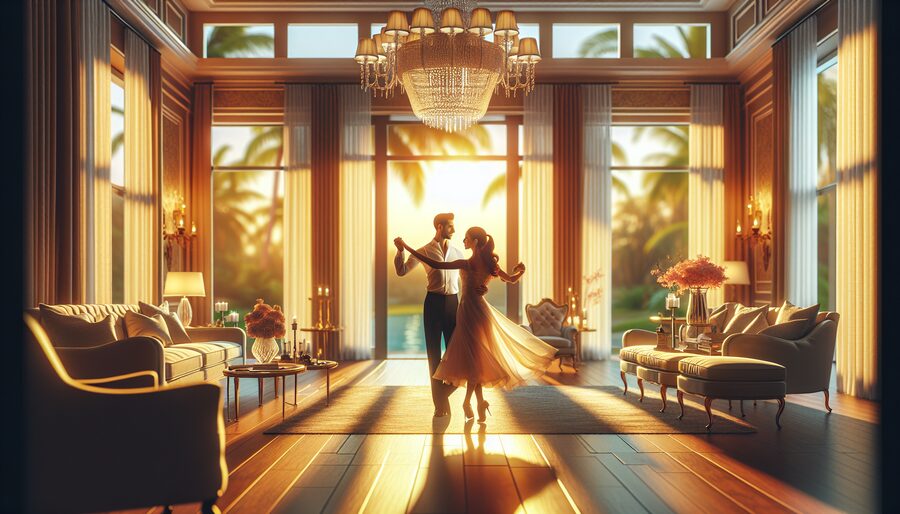
Your instructor arrives at 6:30 PM. No one's frustrated yet. The music starts—your music. For the next hour, it's just you (and your partner, if you have one) and expert guidance.

Maybe you're learning the Rumba for the first time. Maybe you're polishing a Waltz you've been working on for weeks. The pace is completely yours. If something clicks, you accelerate into it. If something needs more attention, you take it.

There's real conversation. Genuine feedback. Laughter. None of the stiffness of performing. By the end, you haven't just learned steps—you've had a genuine experience in the comfort of your own space.

Then your instructor leaves. No commute for you. You're already home, already relaxed, already celebrating what you just accomplished.

The Gala Ballroom Difference

At Gala Ballroom, private in-home instruction isn't a convenience add-on — it's our core model because we know it works.

Our instructors specialize in teaching adults — many of them beginners with zero prior dance experience. We bring world-class technique directly to your door anywhere in Palm Beach County: West Palm Beach, Boca Raton, Delray Beach, Jupiter, Wellington, Palm Beach Gardens, Lake Worth, Boynton Beach, and surrounding areas.

Whether you're learning Salsa, Bachata, Waltz, Foxtrot, or anything in between, every lesson is completely tailored to your goals, your music preferences, and your pace. No contracts. No pressure. No studio overhead.

Just expert instruction and genuine results.

The Bottom Line

Dance studios didn't fail—they're just not the best vehicle for learning if you care about results, comfort, and actually enjoying the process.

Private in-home lessons solve every problem the studio model creates. You skip the commute stress, the crowded floor anxiety, the divided attention, and the wrong music. You get your own space, your own pace, your instructor's full focus, and science-backed learning conditions.

And you progress faster. That's not a bonus—that's a fundamental difference in how you actually acquire skill.

Ready to Experience the Difference?

If you've been thinking about learning to dance—or if you tried studios and it didn't stick—give private in-home lessons a try. You might be surprised how much faster you learn when you're actually comfortable.

Call us at (561) 523-4133 or reach out online to book your first lesson.

Let's bring the world-class instruction to you.