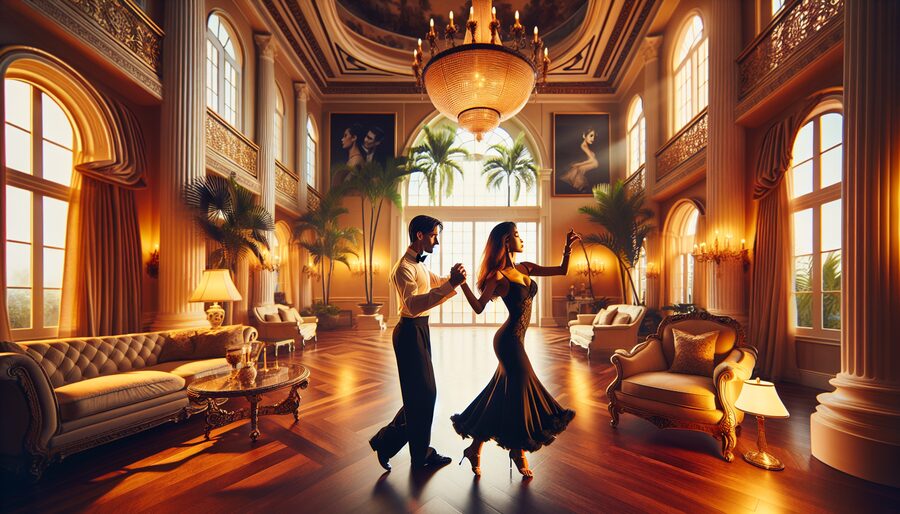
Most people who want to learn to dance have already wanted it for years. The delay isn't lack of interest — it's the mental picture that comes with "taking dance lessons." The fluorescent-lit studio. The rows of strangers watching each other fumble through beginner footwork. The vague sense that everyone in the room started last season and already knows more than you. The drive across town. The parking. The schedule that doesn't quite fit.

If any of that sounds familiar, it's worth knowing that none of it applies when Gala Ballroom comes to your home. The entire experience — from the moment we arrive to the last minutes of the session — is structured around one thing: your comfort, your pace, and your progress. Not a class agenda. Not a curriculum designed for a roomful of strangers. Yours.

Here's exactly what to expect from your first in-home dance lesson in Palm Beach County.

Before We Arrive: Almost Nothing to Prepare

The most common question people ask before their first lesson is some version of: "What do I need to do?" The honest answer is almost nothing.

You don't need a dedicated dance floor. A cleared living room, a tiled kitchen area, a screened lanai — most Palm Beach County homes have at least one space that works beautifully. We've taught on hardwood floors in West Palm Beach bungalows and on large marble entries in Boca Raton estates. Both are great. What matters is that you're at ease in the space, not that the space is architecturally perfect.

You don't need special shoes for a first lesson, though smooth-soled shoes (or going barefoot on certain surfaces) can help. You don't need to have watched YouTube tutorials. You definitely don't need any previous dance experience — our most rewarding first lessons are often with people who've never danced a step in their lives and have no idea what they're getting into.

The main preparation is simply: be there, be comfortable, and have roughly 60 to 90 minutes available. That's it.

The First Ten Minutes: A Conversation, Not a Drill

We don't walk in and immediately start counting beats. The first part of any first lesson is a genuine conversation — what brought you to this, what you're hoping to get out of it, any physical considerations we should know about, what styles you've been drawn to or curious about.

This matters more than it might seem. Dance instruction that actually works is responsive. It adapts to how you move, how you process new information, what you respond to. That calibration can only happen through conversation and early observation — not through a pre-set lesson plan that gets executed whether or not it fits you.

If you're learning for a specific reason — a wedding first dance, a milestone birthday party, a charity gala where you'd like to actually feel good on the floor — that context shapes everything. We'll orient the entire session around the goal that's real for you.

If you're learning simply because you've always wanted to, and you don't have a particular event in mind, we'll explore a style or two that matches your personality and see what clicks.

The Body of the Lesson: Progress That You Can Actually Feel

Here's what's different about private instruction compared to a group class or a studio setting: the feedback loop is immediate and continuous. In a group class, an instructor might correct the most common mistakes and address the slowest students — which means students who pick things up at a different pace, or who have a specific sticking point, often spend an hour practicing a mistake rather than correcting it.

In a private in-home lesson, the only student is you (or you and your partner). Every observation, every correction, every encouragement is targeted. If your left arm is doing something unusual, we catch it in the first pass, not three weeks later. If your partner is the one who needs an adjustment, we work on that in context, together, rather than pulling one person aside and disrupting the whole group.

Most people feel the difference within the first 20 minutes. The progress is visible and tangible in a way that group instruction rarely offers. By the end of a first session, most beginners can move through a recognizable pattern — a basic salsa, a waltz box step, a cha-cha rhythm — with actual confidence. Not perfection. Confidence. There's a significant difference.

The Setting Changes Everything Psychologically

This is the piece that most people don't anticipate: how different it feels to learn in your own home versus a rented studio space.

Studios are designed for efficiency. They serve many students, they have schedules to keep, and the physical environment — mirrors everywhere, high traffic, the residual energy of whoever was in the room before you — all carry subtle psychological weight. You're a guest in someone else's space. You're aware of being observed. You carry the studio's agenda even if nobody imposes it on you explicitly.

Your home is yours. The music sounds different when it's playing in the room where you have dinner or where you read in the mornings. You're not self-conscious about making mistakes because there's no audience to perform for. The familiar surroundings create psychological safety that directly accelerates learning — not as a theory, but as something you'll notice in real time. People loosen up faster, laugh more easily, take risks they wouldn't take in a public setting, and as a result, they progress faster.

For our clients across Palm Beach County — in West Palm Beach, Boca Raton, Delray Beach, Jupiter, Wellington, Palm Beach Gardens, and Lake Worth — the at-home format has consistently produced the most committed students and the fastest improvement. When learning happens in a comfortable, familiar space, it sticks differently than learning in a place you have to drive to and prepare for.

Common First Lesson Styles: What We Might Explore

Every first lesson is different, but a few styles are particularly well-suited to beginners and to in-home settings:

Salsa — High energy, deeply musical, and immediately rewarding. The basic step is accessible in minutes, and once you have it, you can start adding turns and patterns that feel genuinely impressive. Particularly popular for couples who want something they can actually use at parties.

Waltz — Timeless and elegant. The box step is one of the most satisfying patterns to learn because it transforms the way you hear music — waltz time is everywhere once you start recognizing it. Ideal for anyone preparing for a formal event or a wedding first dance.

Cha-Cha — Playful, rhythmic, and versatile. One of the most fun beginners' styles because it's inherently cheerful — the rhythm practically demands a smile. Works beautifully in a home setting because it doesn't require a huge floor.

Rumba — Slow, sensual, and deeply connected. For couples who want something intimate and expressive, rumba rewards patience and attentiveness in a way that faster styles don't. A natural fit for anyone who wants to feel genuinely musical on a dance floor rather than just correct.

We'll point you toward the style that makes the most sense given your goals, your body, and what lights up your interest — not toward whatever happens to be on the curriculum that week.

After the First Lesson: What Comes Next

By the end of a 60-minute session, you'll have a clear sense of what you're working on and why. We'll talk about what clicked, what to practice before the next session, and what's on the horizon as you continue. There's no pressure to commit to a long package on the first lesson — we'd rather you feel genuinely excited about continuing than signed up for something you're not sure about yet.

What most people discover after their first session is simpler than any sales pitch: they want to keep going. The hesitation that held them back for years — the studio anxiety, the scheduling friction, the "I'm not a dancer" self-narrative — starts to dissolve the moment they actually move. Dance is a physical experience. It doesn't fully make sense as an idea. It only makes sense when you're doing it.

If you've been thinking about starting, that first lesson is the most important one. Everything else follows from there.

Gala Ballroom offers private in-home dance lessons throughout Palm Beach County — West Palm Beach, Boca Raton, Delray Beach, Jupiter, Wellington, Palm Beach Gardens, Lake Worth, and Boynton Beach. We come to you. We work on what matters to you. And we make it worth your time from the very first session.

Call us at (561) 523-4133 or reach out online to schedule your first lesson. No experience necessary.