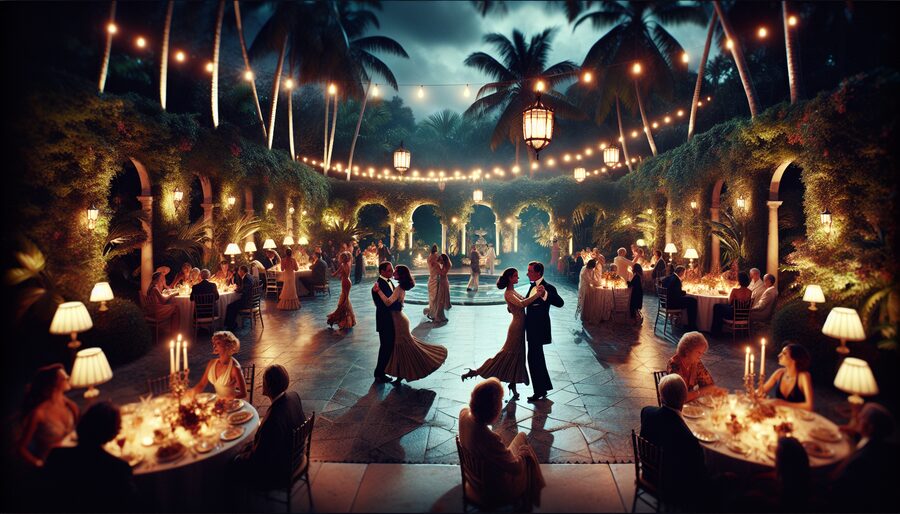
Spring in Palm Beach County is its own thing. The weather finally cooperates — warm without being punishing, breezy without being disruptive — and the landscape rewards anyone who bothers to pay attention. Bougainvillea in full bloom, golden afternoon light that lingers until nearly eight, the kind of evenings where being outdoors feels like a privilege. It's also, not coincidentally, the perfect season to host something genuinely memorable at home.
Not a cookout. Not a cocktail hour that winds down awkwardly after an hour. A real evening — one with a shape and a feeling and a through-line that guests remember months later. A dinner dance party.
The concept is older than it sounds, and it's due for a revival. Here's how to pull one off beautifully, right in your own home or backyard, without the logistical nightmares of renting a venue or the flatness of a playlist-only event.
Why "Dinner Dance" Works Better Than Either Alone
There's a structural problem with most parties: the energy peaks early, then drifts. People arrive, they eat, they drink, they talk — and then somewhere around 9 PM the momentum stalls. The evening technically continues but it's lost its shape. Guests start doing the mental math on the drive home.
A dinner dance format solves this by design. The meal anchors the first half of the evening — it gives people a reason to arrive, a structure for conversation, a shared experience that builds connection. Then the dancing opens up a completely different register. Energy rises instead of falling. People who barely spoke at dinner end up dancing next to each other and laughing. The arc of the evening actually goes somewhere.
In Palm Beach County, where many of the most beloved social traditions involve some combination of beautiful food and beautiful movement — think of the galas at the Kravis Center, the charity balls, the country club dinners that spill onto the dance floor — the format has deep roots. Bringing that energy into a private home setting is not just possible. Done well, it's often more intimate and more memorable than any venue event.
The Right Space: You Have More Than You Think
The first thing people say when they hear "dinner dance at home" is: I don't have a ballroom. Which is true for virtually everyone, and also irrelevant.
A dance floor doesn't require a dedicated room. It requires cleared space — and almost every home in West Palm Beach, Boca Raton, Delray Beach, or Palm Beach Gardens has cleared space when furniture is moved. A living room with the coffee table pushed back. A dining room with the table against the wall. A screened lanai or a back patio. These spaces work. In fact, they often work better than a formal venue because they carry warmth and familiarity that no rented ballroom can replicate.
For outdoor events, the calculation is even simpler. A pool deck, a garden patio, a stretch of flat lawn — all of these become a dance space the moment you clear them and add some light. String lights strung from a pergola or draped between trees do more to set an atmosphere than almost anything else you can add, and they cost almost nothing relative to the effect they create.
The practical floor requirements for most social dancing styles: about 10 by 10 feet for a couple to move comfortably through basic patterns, larger if you want multiple couples on the floor simultaneously. For a group of 12 to 20 people, a 20 by 20 cleared area is ample. Most homes can find that space.
Entertainment: The Element That Makes or Breaks It
Playlist-only events are fine. They're also forgettable in a particular way — the music is present but nobody is accountable for it, nobody is reading the room and responding, and there's no focal point that invites people to actually get up and dance.
Live entertainment changes the dynamic entirely. When a violinist is playing in the corner during dinner — real strings, real presence, music that responds to the energy in the room — it elevates the meal from an event into an experience. Guests stop scrolling their phones. Conversations deepen. The atmosphere becomes something worth being present for.
And when the entertainment shifts from background performance to a featured dance moment — a live violin performance paired with a professional demonstration, or a brief group dance instruction session that gets guests on their feet — the evening transforms. People who said they "don't dance" find themselves doing it anyway, laughing, slightly breathless, genuinely surprised by themselves.
Gala Ballroom specializes in exactly this format. Our live performances for private events combine professional violin and ballroom/Latin dance in a way that works both as background atmosphere during dinner and as featured entertainment later in the evening. We've performed at private homes from Wellington to Palm Beach Gardens to Boynton Beach, in settings ranging from intimate dinner parties for a dozen guests to larger garden gatherings. The format scales naturally — we bring what the space and the moment call for.
Choosing the Right Dance Styles for a Home Party
Not all dance styles suit a home setting equally. Some need significant floor space or specific music arrangements. Others are naturally compact, social, and easy to get guests participating in — even guests with zero dance experience.
For a spring dinner dance in South Florida, these styles hit the mark:
Cha-Cha — The quintessential social dance for a reason. The rhythm is infectious, the basic step is learnable in about five minutes, and the overall energy is upbeat and fun without being overwhelming. Cha-cha works on almost any floor, in almost any amount of space, with almost any group. It also pairs beautifully with the Latin music that feels natural during a warm Florida evening.
Salsa — High energy, deeply musical, and immediately social. A professional demonstration followed by a brief group lesson is one of the fastest ways to get an entire party on its feet. The learning curve is accessible, the music is irresistible, and even the guests who "can't dance" usually discover that they can when someone patient and skilled shows them the first three steps.
Foxtrot — For a more formal dinner dance with a slightly older or more classically inclined guest list, foxtrot brings elegance without stuffiness. It moves slowly enough to allow conversation while dancing, which makes it uniquely suited to an intimate setting where connection is the point.
Merengue — Often overlooked but wildly effective as a party starter. Merengue has one of the most forgiving rhythms in social dance — the step is literally a march — which means guests who've never danced in their lives can be on the floor and smiling within two minutes of being shown the basics. It's impossible to not feel the music once you have the step.
The best approach for a home event: let a professional guide the transition from dinner to dancing. A brief demonstration during or after dessert — something that catches guests' attention and makes them curious rather than self-conscious — followed by an open invitation to join in. The guests who want to watch will watch. The guests who want to participate will jump in. Both are having fun.
The Practical Timeline That Works
For a spring dinner dance running from 6 to 10 PM, a timeline that works well in Palm Beach County's outdoor-friendly climate:
6:00 – 6:30 PM: Arrival and cocktails. Background violin during this window does double duty — it signals that this is a more considered kind of event, and it relaxes guests who are still arriving and settling in. The music doesn't demand attention; it rewards it.
6:30 – 8:00 PM: Dinner. Continue with ambient live music or a curated playlist. The meal is the anchor — keep the energy warm and the pace unhurried. This is the half of the evening that sets up the second half.
8:00 – 8:20 PM: Featured performance. A live violin and dance demonstration gives the evening a clear "now we're in a different mode" moment. Guests who've been sitting and talking for 90 minutes are ready for something to happen. This is when it happens.
8:20 – 10:00 PM: Open dancing. With the professional there to guide, encourage, and keep the energy moving, the floor stays active. This is where the memories are made — the first-timer who discovers she's a natural, the couple who hasn't danced together in twenty years, the friend group who ends the evening closer than they arrived.
What to Book, and When
Spring weekends fill quickly in Palm Beach County. March through May is high season for private events — the combination of favorable weather, post-season social energy, and the natural momentum of graduation, anniversary, and milestone-birthday gatherings means that entertainment providers are in demand.
If you're planning a spring dinner dance for April or May, mid-March is the practical window to book. Not because things are sold out — though they can be — but because booking early lets you plan the rest of the event around the entertainment you've secured rather than retrofitting whatever's still available.
Gala Ballroom books private event performances throughout Palm Beach County. We also offer private dance lessons in your home ahead of your event — ideal if you'd like to feel confident on the floor as the host, or if you want to surprise your guests with some moves they weren't expecting from you.
To talk through what would work for your space, your guest list, and the evening you're envisioning, call us at (561) 523-4133 or get in touch online. We love this kind of event. We're good at it. And we'd be glad to help you make yours the one your guests are still talking about in July.