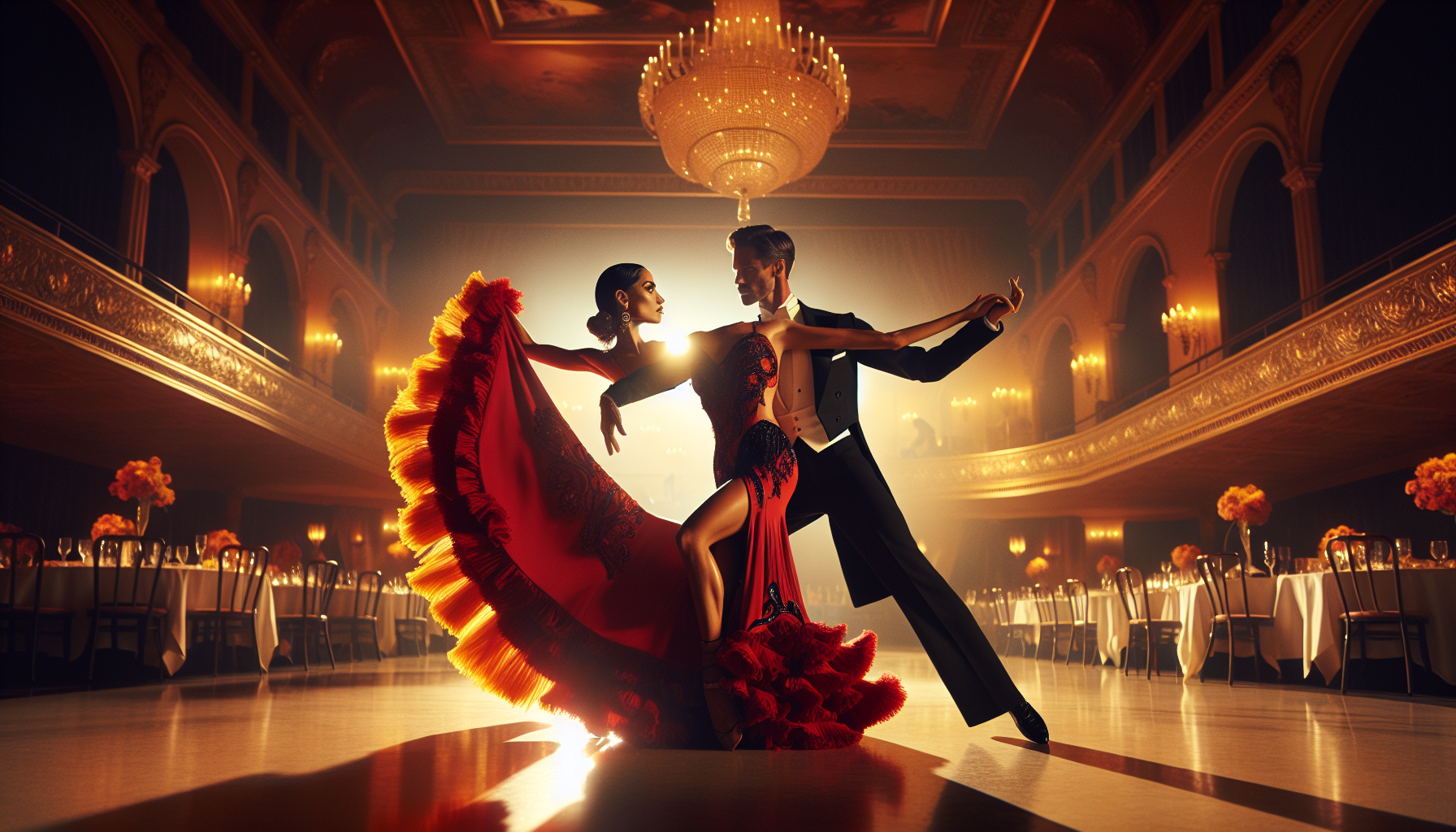
Most dances invite you to move. Paso Doble demands that you become something.
In the entire world of ballroom and Latin dance, there is nothing quite like it. While the waltz floats, the tango smolders, and the samba bounces, Paso Doble marches — with purpose, with fire, with the theatrical conviction of a matador entering the arena. It is bold, structured, and when done well, absolutely electrifying to watch.
It's also one of the most underrated dances you can learn in South Florida — and at Gala Ballroom, we think it deserves a lot more attention.
What Is Paso Doble?
The name literally translates to "double step" in Spanish, referring to the brisk, march-like music it's performed to — typically played at around 60 beats per minute with a sharp, military cadence. But the dance itself draws its spirit not from military marching, but from the tradition of the Spanish bullfight.
In Paso Doble, the man takes the role of the matador — the bullfighter — while the woman represents either his flowing cape (the capote) or, in more powerful moments, the bull itself. This isn't just a metaphor for how you hold your arms. It shapes the entire character of the dance: the man leads with chest-forward authority, the woman moves with sweeping, dramatic grace around him, and together they create something that looks less like a social dance and more like live theater.
Paso Doble is one of the five international Latin dances in competitive ballroom (alongside cha-cha, samba, rumba, and jive), and it consistently gets the biggest audience reaction at competitions and performances. When the music starts and the couple strikes that first pose — spine long, chin lifted, arms sculpted — people stop and stare.
Why Palm Beach Is the Right Place to Learn It
South Florida has a deep relationship with theatrical performance culture. From the charity galas in Palm Beach to the black-tie events at country clubs throughout Wellington, Jupiter, and Boca Raton, there are countless settings where Paso Doble's dramatic presentation wouldn't just fit — it would absolutely own the room.
Palm Beach County's social scene rewards people who carry themselves well. The posture alone that you develop from learning Paso Doble — that lifted chest, the broad, grounded stance, the sense of physical command — translates into every formal event you attend for the rest of your life. You carry it whether you're dancing or not.
And for event entertainment, Paso Doble is in a class by itself. We've performed it at galas and private celebrations across South Florida, and the response is unlike anything else. It's not background music. It's a moment. When that march starts and the performance unfolds, guests aren't talking anymore — they're watching.
The Core Elements: What You're Actually Learning
Paso Doble may look impossibly advanced, but it's built on a surprisingly accessible foundation. Here's what the dance is actually made of:
The Sur Place and Chassé
The most basic element — marking time in place with a quick rhythmic step — is called the sur place. From there, you learn the chassé, a traveling step that moves the couple across the floor with precise, confident strides. These two movements form the backbone of nearly every Paso Doble routine, and most students have them down within the first couple of lessons.
The Appel
One of the most distinctive elements of Paso Doble is the appel — a sharp stamp of the foot that punctuates the music like a gunshot. Done right, it's one of the most dramatically satisfying movements in all of dance. Done wrong, it just sounds like you dropped something. The difference is in the intention and the timing, which is exactly what private instruction addresses directly.
Arm Styling and Cape Movements
Where Paso Doble becomes truly striking is in its arm work. The woman's sweeping cape movements, the man's rigid sculptural lines, the dramatic promenades where one partner passes around the other like a matador working the ring — this is where the theater lives. And while it looks complex, these are learned movements with clear patterns. With focused private lessons, students absorb this much faster than they expect.
Character and Expression
More than any other ballroom dance, Paso Doble requires you to actually perform. The steps alone, without the character, look mechanical. The character alone, without the steps, looks chaotic. When they come together — when the footwork is solid enough that your attention can shift to expression — something remarkable happens. Students often describe a lesson clicking into place like a light switch. Suddenly you're not learning moves; you're telling a story.
The Physical Benefits: More Than You'd Expect
Paso Doble is deceptively athletic. The upright posture throughout the dance demands constant engagement from your core and lower back. Maintaining that lifted chest and long spine while executing precise footwork and arm movements builds functional strength in ways that conventional exercise rarely touches.
Research on postural training has consistently shown that dances requiring sustained vertical alignment — particularly those with marching or stamping elements like Paso Doble — produce measurable improvements in spinal stability and balance within just a few weeks of regular practice. For South Florida residents navigating everything from formal events to outdoor terrain in dress shoes, that kind of stability matters.
The dance is also cognitively demanding. Learning to interpret the dramatic musical phrases, coordinate footwork with arm styling, maintain character, and lead or follow your partner simultaneously gives your brain an extraordinary workout. This kind of multi-layered motor and interpretive learning has been associated with improved executive function and memory retention — benefits that extend well beyond the dance floor.
Paso Doble for Events and Performances
One of the most common reasons people book Paso Doble lessons with us isn't for social dancing — it's for a specific event. Maybe they're planning a gala performance, a surprise anniversary celebration, or they've been asked to contribute something special to a formal occasion. Paso Doble is an extraordinary choice for any of these contexts.
Because the dance is so inherently theatrical, even a relatively short routine — one to two minutes — creates a complete dramatic arc that an audience experiences as a full performance. Unlike more social dances that read as "people dancing nicely," Paso Doble reads as an act. It commands attention. It builds. It lands.
If you're planning a private party, charity gala, or milestone celebration anywhere in Palm Beach County — West Palm Beach, Boca Raton, Delray Beach, Lake Worth, Wellington — a Paso Doble performance by Gala Ballroom is something your guests will be talking about long after the evening ends. Visit our performances page to learn more about event entertainment options.
Learning Paso Doble at Home: Why It Actually Works Better
The theatrical intensity of Paso Doble can feel intimidating in a group class environment. You're being asked to stamp your foot, strike poses, and project commanding energy — all while strangers watch and the instructor is across a crowded room. For most people, that's not a recipe for learning anything well. It's a recipe for shrinking.
Private in-home lessons eliminate all of that. In your own living room in West Palm Beach, Boca Raton, or anywhere across Palm Beach County, you can be theatrical without an audience, work through the dramatic elements without self-consciousness, and actually let the character develop. The environment matters enormously for a dance like this. Paso Doble needs space — not just physical space, but psychological space — to really take root.
We come to you, we bring the music, and we work through the dance at your pace. The first time you nail the appel and feel it land in the beat, you'll understand why people get hooked on this dance. It's a feeling that's genuinely hard to replicate elsewhere.
Who Is Paso Doble For?
Honestly? Anyone who's ever felt a pull toward something dramatic. Paso Doble doesn't require you to already be a performer — it tends to reveal the performer that was already there. Students who describe themselves as shy or reserved regularly surprise themselves in Paso Doble lessons. There's something about the structured character of the dance that gives people permission to take up space in a way they don't usually allow themselves.
Couples find it particularly transformative. The man-leads-with-authority, woman-sweeps-around-him dynamic creates a playful power dynamic that many couples find deeply fun to explore. It's not about gender roles in any limiting sense — it's about playing characters together, which turns out to be a genuinely bonding experience.
Solo students learning the matador role develop a kind of physical confidence that carries far beyond the dance. And students learning the cape role often say it's the most physically expressive thing they've ever done.
Your Next Step
Paso Doble is the dance that proves something: you don't have to be boring just because you're dancing formally. There's room for fire, for drama, for genuine theatrical presence in the world of ballroom — and this dance is where it lives.
South Florida's event calendar is full of opportunities to use it. Your body is capable of it. And learning it privately, at home, with focused instruction, is the fastest and most enjoyable path from curious to confident.
If you've been looking for a dance that matches the scale of who you actually are when no one's watching — Paso Doble might be it.